

FOR Energy project owners, EPC contractors, and project directors
Allocate responsibility across the EPC scope
An EPC agreement brings design, procurement, and construction into one commercial framework, but insurance responsibilities still need to be separated. Identify the contracting entities, design responsibility, equipment purchasing arrangements, subcontractors, and the party arranging project insurance. Do not assume the EPC label determines which risks are insured.
Review the project from early engineering through delivery, installation, testing, and handover. Each stage can involve different property interests and contractual duties. A clear responsibility matrix helps reveal gaps between the owner’s insurance, contractor policies, supplier obligations, and any project-specific placement.
Coordinate physical works and professional exposures
Construction damage, design allegations, defective equipment, and failure to meet performance criteria are different issues. Review builders risk or erection-related protection separately from professional liability and general liability. Ask how defects, resulting damage, testing, and property being worked on are treated under the actual wording.
Identify whether design is performed internally or subcontracted, and whether the EPC contractor assumes responsibility beyond its own work. Counsel should assess warranties and performance commitments. The broker should examine whether professional services and assumed obligations fit the proposed terms rather than describing project insurance as a guarantee of successful performance.
Review delay, testing, and handover boundaries
A project may be mechanically complete but still require testing, commissioning, or performance acceptance. Ask when the construction policy ends, when operational coverage begins, and how partial acceptance or phased startup is treated. Unclear handover dates can create uncertainty about both property and interruption interests.
Evaluate any delay-related insurance separately from liquidated damages and other contractual remedies. Document critical equipment, replacement lead times, and the financial interest intended to be insured. Do not assume every delay, cost overrun, or failure to achieve output is an insured event under a project policy.
Create a project insurance decision schedule
Collect the EPC contract, insurance specifications, project values, schedule, design agreements, supplier terms, and major subcontract documents. Establish review points for equipment shipment, construction start, testing, and operational transfer. Keep changes in scope and contract value visible to the insurance team.
The final record should state who arranges each policy, who is insured, relevant deductibles, reporting obligations, and unresolved exclusions. Obtain written confirmation of material terms before work begins. The objective is coordinated risk allocation across the project, while recognizing that some commercial promises remain a business decision rather than an insurable exposure.
For owner-furnished equipment, identify when the EPC contractor takes custody and whether it assumes responsibility for suitability or only installation. This distinction can affect both property and professional-services analysis. The project insurance schedule should show delivery, storage, installation, and acceptance milestones for those items, because they may not follow the same procurement route or contractual allocation as contractor-purchased equipment.
Questions for your next review
- Who arranges project property and professional liability insurance?
- How are testing and partial handover treated?
- Which performance and delay obligations remain uninsured?
Related Montridge webinars
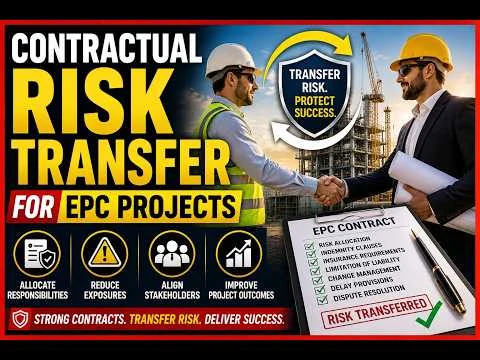
EPC, contracts and commercial coverage
Contractual Risk Transfer for EPC Projects
Clicking Load video connects to YouTube. No player loads automatically.
Watch on YouTube ↗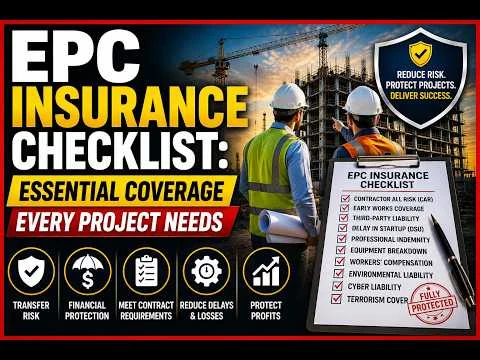
EPC, contracts and commercial coverage
EPC Insurance Checklist: Essential Coverage Every Project Needs
Clicking Load video connects to YouTube. No player loads automatically.
Watch on YouTube ↗Connect this topic to your program
Bring the operational details above into a coordinated review of your contracts, loss history and actual policy wording. Explore Montridge EPC insurance services for the related brokerage service.
Source references
Primary-source background informs the technical discussion. Insurance review questions are educational interpretation; a source link does not establish coverage or certify compliance.
Prepared November 1, 2026. Confirm current requirements and their application to your work before relying on them. Specific insurance outcomes require review of the complete policy and endorsements.